Observability

Business Observability is the practice of obtaining real-time insights and end-to-end visibility into how IT systems, applications, and customer interactions impact business goals, enabling organizations to understand, predict, and optimize performance by correlating technical data (logs, metrics, and traces) with business outcomes (KPIs, revenue, and financial indicators), to support faster and better-informed decisions.

It goes beyond simple monitoring, providing in-depth context and connecting what is happening in the technological environment to why it is important for the business.

Main aspects

Holistic view: Integrates data from infrastructure, applications, customer journeys, and business events.

Alignment between IT and Business: Connects technical performance directly to business metrics, such as sales or customer satisfaction.

Proactive and predictive: It helps teams anticipate problems, automate fixes, and find optimization opportunities, instead of just reacting to alerts.

Contextual understanding: Correlates technical signals (metrics, logs, traces) to understand the "why" and "how" behind business performance.

How it works

It’s like having a real-time dashboard that shows not only server load (IT), but also how that load impacts the customer’s ability to complete a purchase (business), and then predicts when the issue may occur again.

1. Data Collection:
Collects telemetry (metrics, logs, traces) from all layers.

2. Correlation:
Links technical data to business events and KPIs.

3. Analysis:
Uses analytics to uncover trends, anomalies, and forecasts.

4. Action:
Enables automated remediation or proactive adjustments to business strategy.

In simples terms

Business Intelligence:

It’s like having a real-time dashboard that shows not only server load (IT), but also how that load impacts the customer’s ability to complete a purchase (business), and then predicts when the issue may occur again.

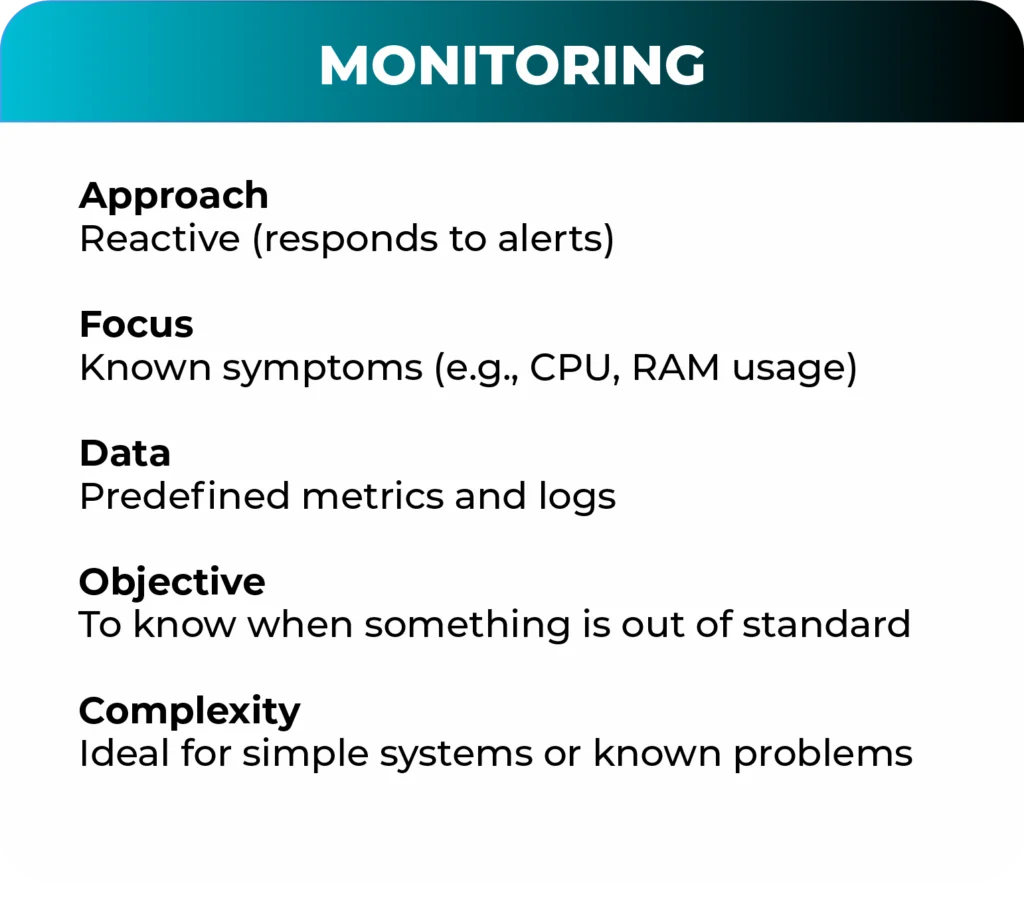
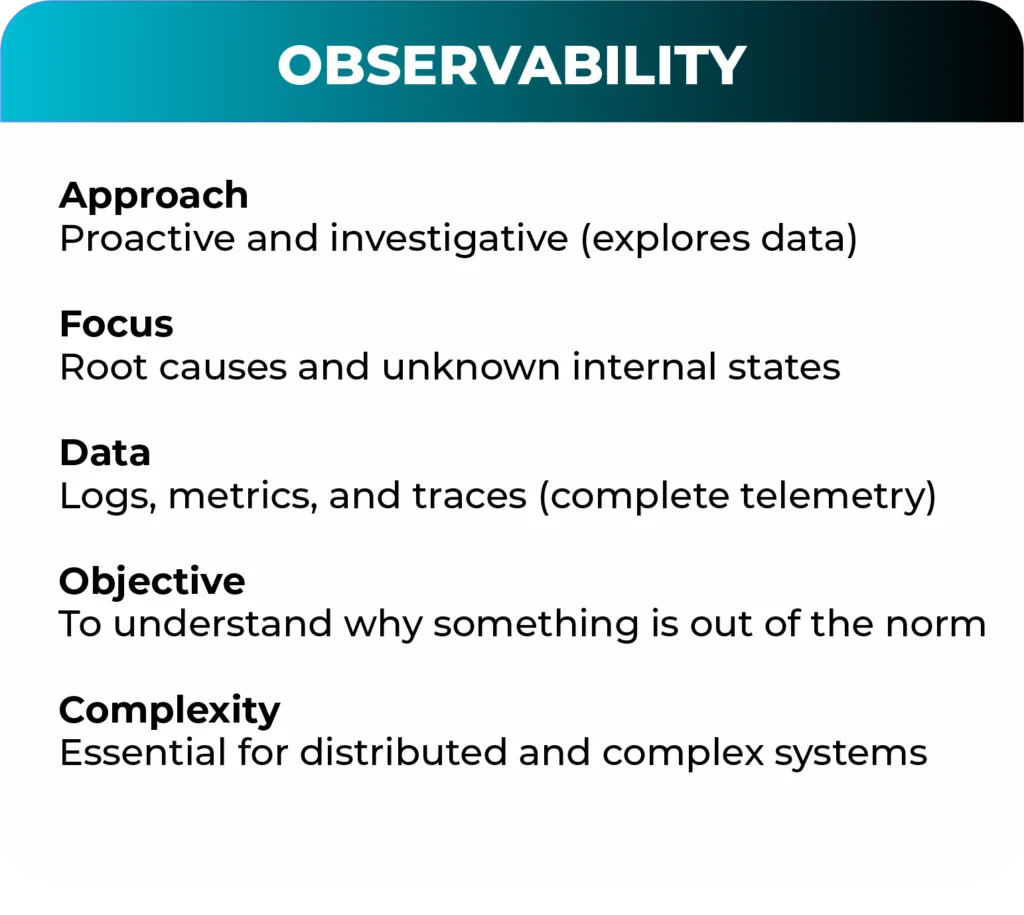
How does it differ from traditional monitoring?

Business Intelligence:

More than monitoring, we correlate technical metrics with business outcomes.

Business Observability:

Focuses on why systems are behaving a certain way and what that means for the business, correlating technical health with business outcomes in real time.

Comparative matrix

Business Observability is the practice of getting real-time, end-to-end insight into how IT systems, applications, and customer interactions impact business goals, allowing organizations to understand, predict, and optimize performance by correlating technical data (logs, metrics, traces) with business outcomes (KPIs, revenue) for faster, informed decisions. It moves beyond simple monitoring to provide deep context, connecting what’s happening in the tech stack to why it matters for the business. 

Possible applications

Emerging Sectors:

Telecommunications:
Network optimization, customer churn forecasting, and 5G infrastructure planning.

Energy:
Smart grid management, renewable energy forecasting, and carbon footprint optimization.

Automotive:
Autonomous vehicle systems, predictive maintenance, and connected car data analysis.

Education:
Analysis of student performance and curriculum optimization tools, operational analysis, performance of curricular activities, security and financial aspects.

Primary Sectors:

Financial Services:
Risk management, fraud detection, and algorithmic trading optimization strategies.

Health:
Support for clinical decision-making, accelerating drug discovery, and predictive patient outcomes.

Manufacturing:
Predictive maintenance, quality control automation, and supply chain optimization structures.

Retail:
Personalization mechanisms, demand forecasting, and customer journey optimization solutions.

Operating model